The modern fast-fashion apparatus operates entirely on planned obsolescence. Fabrics are deliberately thinned below 140 gsm, critical locking stitches are omitted to shave seconds off assembly line quotas, and seasonal palettes are rotated every twenty-one days to render your wardrobe psychologically obsolete. This is not sustainable apparel engineering; it is a global engine for textile decay.
At NINOC Studio, we reject arbitrary seasonal calendars. We evaluate every prototype against a singular architectural metric: will this garment retain its structural integrity and aesthetic dignity when pulled from an archival trunk fifteen years from today?
01. 310 GSM Density and Long-Staple Cotton Selection
Our construction methodology originates at the fiber level with long-staple combed cottons. Extended staple length allows for tighter yarn twisting during spinning, eliminating abrasive surface pilling while supporting dense, heavy-loop 310 gsm weights that remain highly breathable across changing thermal loads.
Every fabric roll delivered to our cutting floor undergoes mechanical pre-shrunk stabilization—avoiding aggressive chemical baths—to cap natural wash shrinkage at a strict 1.5 percent threshold. This rigorous pre-shrinking ensures that the silhouette geometry tested across our studio floor maintains its exact proportions across hundreds of rigorous industrial laundry cycles.
“A properly engineered garment should never require fragile, neurotic care instructions. Archival clothing must withstand physical abrasion, heavy laundering, and environmental friction without losing its structural foundation.”
02. 42-Stitch Bar-Tack Structural Reinforcements
In our forensic analysis of outerwear and heavy knit wear-and-tear, structural failures rarely manifest within open fabric panels. Catastrophic tears almost exclusively originate at mechanical stress concentration points: pocket welts subjected to habitual hand insertion, armhole junctures during sudden extension, and bottom placket seams.
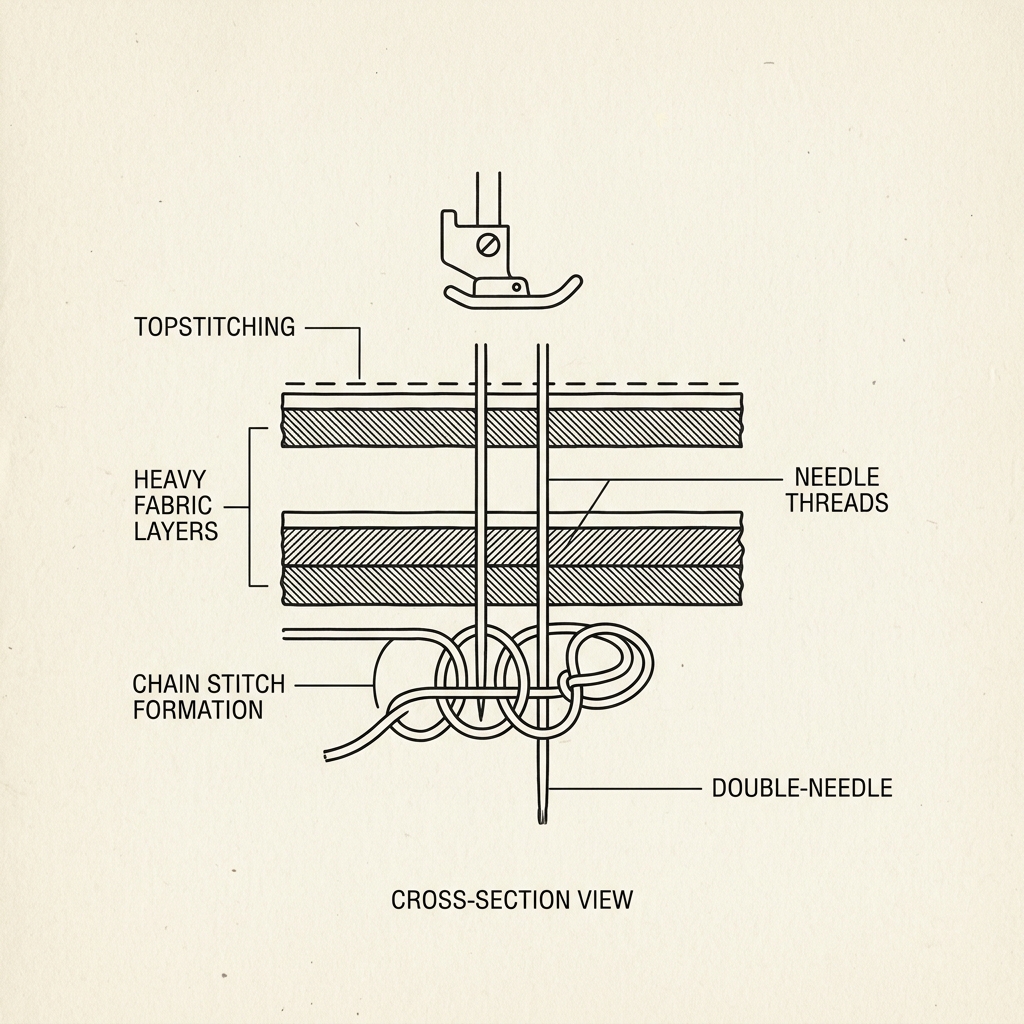
To eradicate these structural vulnerabilities, we reinforce every critical stress intersection with high-density 42-stitch bar-tacks executed on heavy-duty industrial SINGER sewing machinery. These dense bar-tacks bind multiple fabric layers under extreme thread tension, distributing mechanical friction evenly across surrounding fibers to prevent seam tearing under sudden load.
03. Double-Layered 2x1 Ribbed Collar Architecture
The neckline serves as the primary visual and structural anchor of any jersey garment. Standard commercial manufacturing deploys thin, low-density ribbed collars that bow, warp, and lose radial tension after four or five routine laundering cycles.
At NINOC, we engineer our necklines utilizing double-layered high-density 2x1 ribbed cotton assemblies. The collar-to-body seam is bound via continuous double-needle chain stitching reinforced by shoulder-to-shoulder cotton taping. This structural assembly acts as an internal tension skeleton, ensuring the collar retains its memory and circular geometry regardless of lifelong daily wear and mechanical strain.