In the cost-cutting calculations of mass-market garment manufacturing, closures—zippers, snap fasteners, and metal buckles—are treated as prime targets for margin optimization. Brands specify generic zinc-stamped zippers to shave mere cents off per-unit factory assembly bills. To us, this represents a fatal engineering oversight.
When you deploy a heavyweight parka or canvas field coat over sustained years of heavy wear, the high-density cotton shell rarely fails first. The primary point of catastrophic failure is invariably the hardware: slider teeth misalign under lateral stress, cheap electroplated coatings pit and oxidize from perspiration, and pull tabs snap off cleanly when yanked in harsh weather. Once the primary closure fails, the entire outer garment becomes functionally inert.
01. The Catastrophic Failure Mechanics of Commercial Zippers
Why do conventional commercial zippers decay with such disturbing rapidity? During standard die-stamping manufacturing, hundreds of metal or composite teeth are stamped simultaneously onto woven fabric tape. This aggressive bulk stamping process invariably leaves microscopic, jagged metal burrs across the inner interlocking faces of each individual tooth.
Each time the user actuates the slider assembly up or down the track, these jagged burrs function as abrasive micro-saws, gradually chewing through surrounding polyester carrier tape. Within twenty-four months of moderate wear, the tape frays, tooth alignment collapses, and the slider assembly jams irreparably or detaches from the track entirely.
“Hardware serves as the load-bearing mechanical spine of any serious outer shell. If your closure binds, jams, or snaps, even the finest textile construction is rendered instantly useless.”
02. Japanese Zenith: Individual Tooth Polishing on YKK Excella
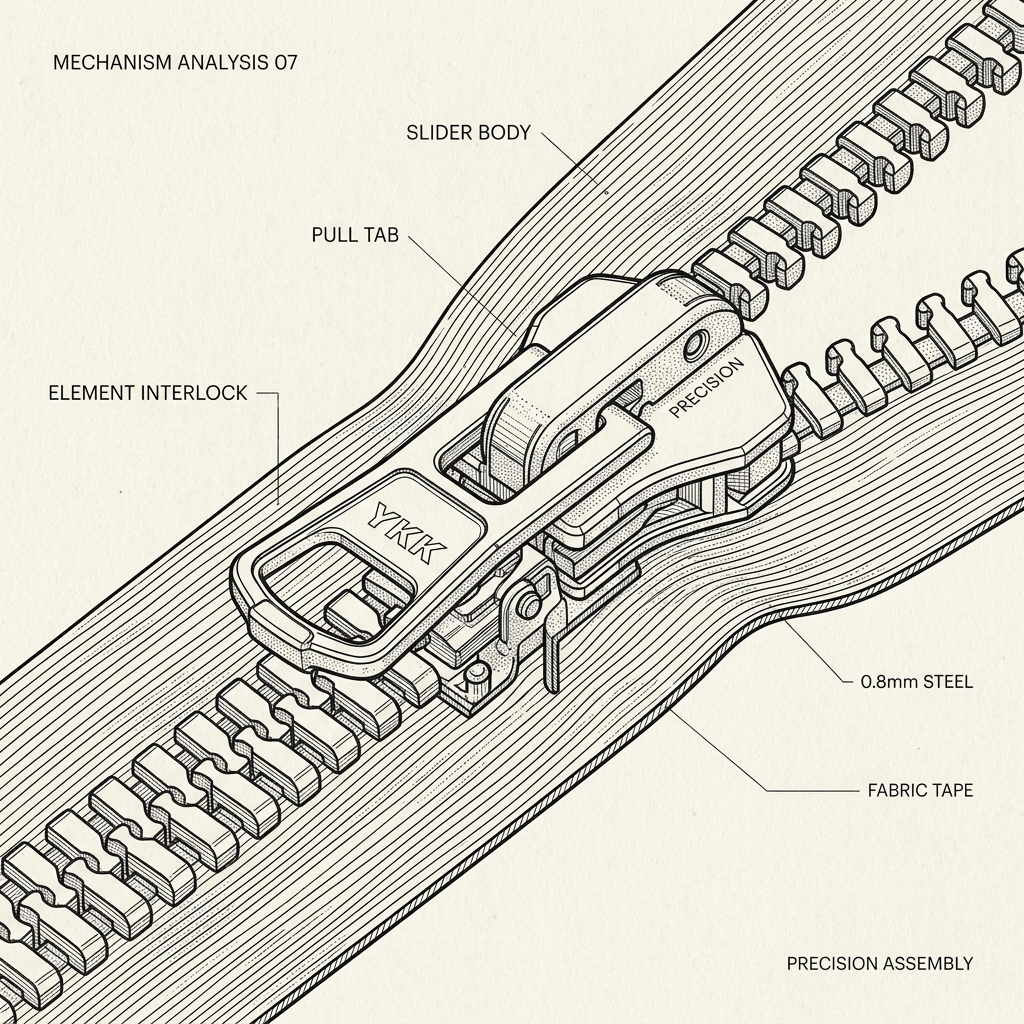
This structural reality dictates why every single NINOC outer layer mandatorily mandates Japanese YKK Excella hardware—the absolute zenith of precision metal closures produced in Japan. Diverging fundamentally from conventional zipper fabrication, each individual tooth element on an Excella track is machined separately from solid brass alloy stock.
Prior to assembly onto high-tensile polyester carrier tape, every single brass element undergoes painstaking individual polishing inside YKK's Japanese manufacturing bays. This individual polishing eradicates 100 percent of microscopic metal burrs, yielding tooth contours that exhibit mirror-smooth, friction-free surfaces.
03. 0.02MM Tolerances and Frictionless Mechanical Glide
The interlocking tolerance between each Excella tooth is calibrated precisely to within 0.02 millimeters. When you actuate the Excella slider from base to collar, you encounter zero abrasive catch, zero binding, and zero harsh metallic chatter. Instead, you experience a smooth, weighted, frictionless glide that feels closer to the bezel action of a fine mechanical timepiece than typical apparel haberdashery.
We do not specify YKK Excella because it is economical; its procurement cost runs up to eight times higher than standard commercial haberdashery. We specify it because the hardware anchoring an archival garment must function with uncompromising mechanical precision across thousands of actuation cycles over decades of sustained field use.