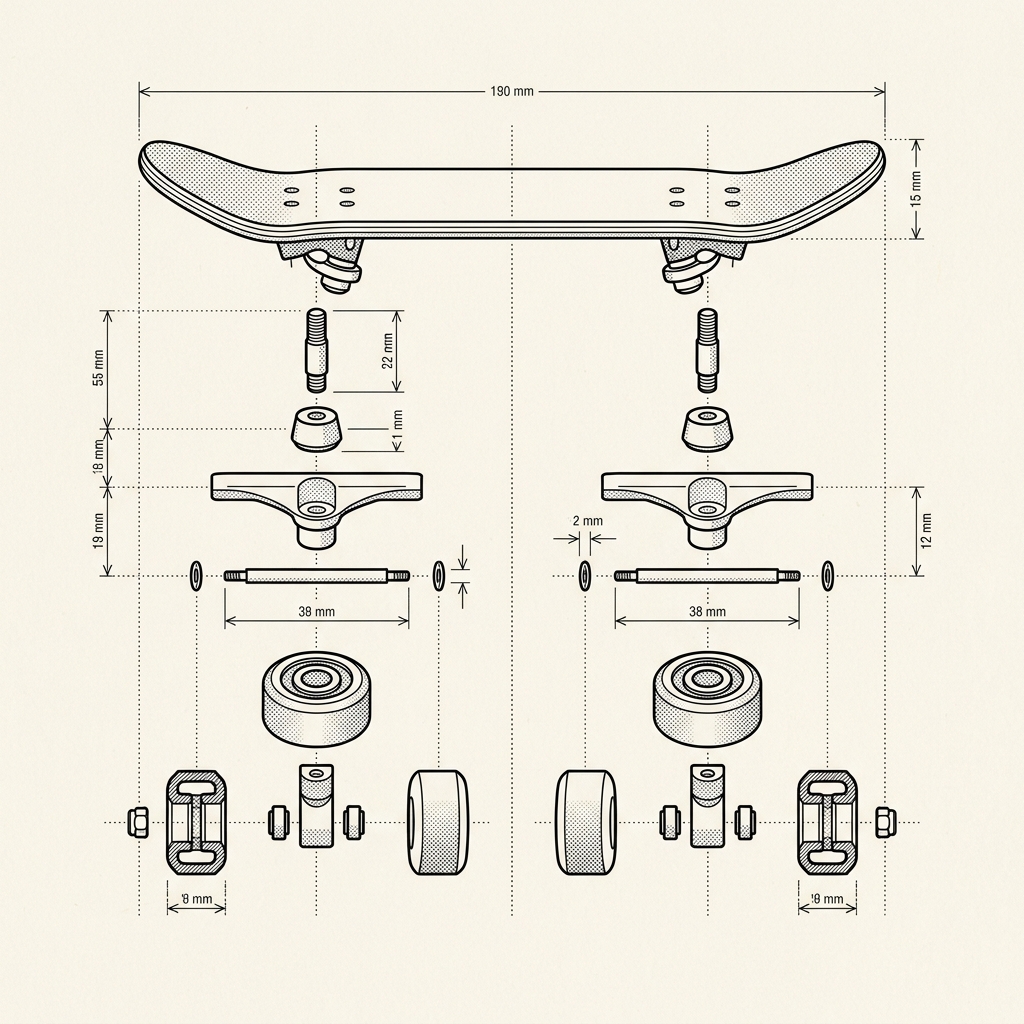
In the mass-market toy sector, fingerboards are stamped out from cheap injection-molded ABS resin in fractional seconds. This hasty molding process leaves sharp parting seams, rigid fixed axles, and hard plastic wheels that skid uselessly across surfaces without friction. The result is a disposable novelty that strips away the actual physics and momentum of skateboarding.
The NINOC Tech Deck collection is approached through rigorous micro-engineering at 1:8 scale, anchored around the industry gold standard: a 96-millimeter deck length paired with a 32-millimeter stance width. Each deck is cold-pressed from 5 individual plies of Canadian maple veneer under high-tonnage hydraulic pressure, forming a precision medium concave that delivers sharp, predictable pop mechanics during finger-actuated ollies and technical flip transitions.
01. 5-Ply Maple Architecture and Concave Geometry
Why do we insist on cold-pressing 5 individual layers of Canadian maple veneer when injection molding is exponentially cheaper and faster? The answer lies in mechanical tensile response. Canadian maple possesses dense, naturally elastic cellular fibers. When five micro-thin veneer sheets are laminated with alternating cross-grain orientation under 15 tons of hydraulic pressure for 12 hours, the resulting deck generates acoustic resonance and kinetic snap that synthetic polymers simply cannot replicate.
The lateral concave curvature alongside the kick angles of the nose and tail are calibrated within a strict 0.5-degree tolerance. Proper tail kick geometry allows the rider's index and middle fingers to achieve optimal leverage during rapid upward transitions from flat surfaces onto steel rails or concrete ledges.
“Miniaturized dimensions never justify compromised mechanical tolerances. A 0.1-millimeter deviation on a fingerboard axle translates to a catastrophic wobble in real-world physics.”
02. Precision CNC Aluminum Truck Tolerances
We reject brittle zinc-cast hardware in favor of CNC-machined aerospace-grade 6061-T6 aluminum alloy trucks. Each axle assembly is lathe-turned within a 0.01-millimeter tolerance threshold, ensuring that mounted wheels never suffer from high-speed axial wobble or binding across long practice sessions across laboratory or studio desks.
To guarantee authentic carving dynamics, each hanger assembly is fitted with custom 95A durometer polyurethane bushings. These dampers provide responsive, organic turning articulation—stiff enough to prevent kingpin shearing under heavy impact landings, yet supple enough to allow fluid turning without inducing deck-to-wheel contact (wheel-bite).
03. Shielded Steel Bearings inside Urethane Wheels
For our wheels, we eliminate hollow, noisy plastic compounds that crack under stress or rattle across desks. Every NINOC wheel is precision-machined from 100D durometer high-rebound urethane housing an integrated ABEC-9 single-shielded steel ball bearing assembly.
When propelled across polished wood, marble, or miniature steel rails, these wheels eliminate abrasive plastic chatter. Instead, they glide with silent mechanical fluidity, generating a clean hum accompanied by authentic surface bite. We deliberately issue our setups as paired units (Set of 2) so riders can immediately test stance transitions and weight distribution across two distinct deck geometries.